
Introduction
When God created the universe, He didn’t roll dice, consult probabilities, or “hope” things would work out. “He spoke, and it came to be; He commanded, and it stood firm” (Psalms 33:9). Probability is something we use when we don’t know what’s going on. It’s a tool for limited minds trying to describe a world that is too deep, too rich, and too ordered for us to see all at once. But of course God sees everything at once — “known to God are all His works from the beginning of the world” (Acts 15:18). So, the universe He made doesn’t operate on “maybe.” It operates on purpose, structure, and design — “He upholds all things by the word of His power” (Hebrews 1:3).
.
Probability Belongs to the Observer
Most of us grow up hearing that the universe is full of randomness — particles jittering around, events happening “by chance,” and outcomes depending on probability. But that’s not how Scripture describes Creation, and it’s not how our sovereign Lord works. “He spoke, and it came to be; He commanded, and it stood firm” (Psalms 33:9). Probability is not a property of the universe — it’s a property of observers who don’t yet see the whole picture.
When Jehovah God created the universe, He didn’t need chance to guide Him, and He didn’t build a world that runs on “luck.” He built a world that runs on order — an order so deep that when we don’t understand it, we call it “random.” “God is not the author of confusion, but of peace” (1 Corinthians 14:33).
The deepest layer of Creation — the layer God spoke into existence — contains no randomness, uncertainty, or probability. Everything in that layer follows a clear, purposeful structure. Nothing “just happens.” Nothing is left to luck. So where does probability come from? From us.
Probability is the language of the observer, not the language of the Creator. We use probability when we cannot see the whole picture. “Known to God are all His works from the beginning of the world” (Acts 15:18). When we look at the universe from the outside — through telescopes, microscopes, and equations — we see flicker, vibration, and motion we cannot fully track. And because we cannot track it, we call it “random.” But it isn’t random to God.
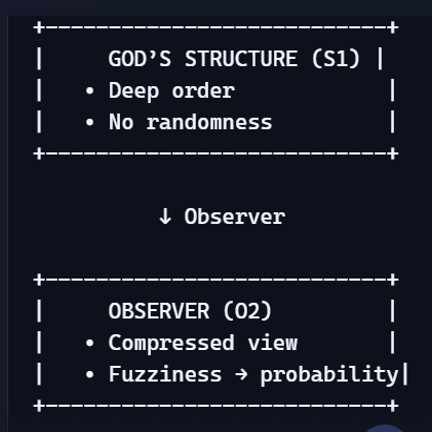
Quantum physics looks probabilistic because our viewpoint merges things that God kept separate. We compress His deep structure into a single picture, and the result looks fuzzy. Probability is our way of describing that fuzziness. It is not the way God designed the universe to operate. In other words:
Probability is a human description of limited knowledge, not a divine description of Creation.
If we want to understand why the universe is not random, we have to look at the deepest layer of Creation — the layer God Himself spoke into existence. Scripture tells us that God created with intention, not accident: “By wisdom the Lord laid the earth’s foundations” (Proverbs 3:19). Wisdom is not probabilistic: Wisdom builds structure.
And structure is the key.
At the foundation of Creation, Jehovah God established a world that is coherent, stable, and self‑consistent. This foundational layer — what we might call the “first layer” of Creation — is where identity, connection, and order are defined. It is the layer where things are what God says they are, and where relationships between things follow the patterns He designed. Nothing in that layer “just happens.” Nothing flickers, jitters, or wavers. Everything follows the structure God set in place.
Structure is precisely the reason this layer cannot be random.
Randomness is what you get when structure is missing. But God did not create a structureless world. He created a world where every part fits into every other part, where boundaries, relationships, and directions are all meaningful. “All His works are perfect” (Deuteronomy 32:4). Perfection is not probabilistic. Perfection is ordered.
So why do we sometimes think the universe is random?
Because we are not looking at the deepest layer. We are looking at the observer layer — the layer where human beings try to reconstruct God’s creation from the outside. When we observe the universe through telescopes, microscopes, and equations, we are not seeing the foundational substrate directly. We are seeing a compressed version of it. We merge things God kept separate. We flatten things God made multidimensional. We try to describe God’s structure using our limited tools.
And when our tools cannot track the full structure, the result looks fuzzy.
That fuzziness is what scientists call “probability.”
But probability is not a property of God’s Creation. It is a property of our reconstruction of Creation. It is what happens when we try to describe a perfectly ordered world using imperfect methods. “We see through a glass, darkly” (1 Corinthians 13:12). That darkness — that limitation — is what produces the appearance of randomness.
In the deepest layer, the layer God authored, there is no randomness at all. There is only structure — structure so rich, so deep, and so coherent that when we cannot see it clearly, we call it “chance.”
But it isn’t chance to God. It is His design.
When we talk about “structure,” many people immediately think of atoms, molecules, DNA, or the laws of physics. But those things are not the deepest structure of Creation — they are results of structure. They are the visible, measurable, scientific expressions of something far more fundamental.
Think of a house. You can describe the house in terms of bricks, boards, and nails. But the house does not exist because of bricks. It exists because of a blueprint. The blueprint is much deeper than the materials. The blueprint is what gives the materials their meaning, their placement, and their purpose.
In the same way, atoms and molecules are the “materials” of creation. But the blueprint — the structure God spoke into existence — lies beneath them. It is the layer where identity, connection, and order are defined. It is the layer where God’s wisdom sets the boundaries of reality. “By wisdom the Lord laid the earth’s foundations” (Proverbs 3:19).
This deeper structure is not physical. It is not made of particles. It is not something a microscope can reveal. It is the organizational logic God built into Creation — the logic that makes atoms possible in the first place. And because this structure comes from God, it cannot be random. “All His works are perfect” (Deuteronomy 32:4).
Randomness appears only when we look at Creation from the outside, using tools that cannot see the blueprint. We see flicker, vibration, and motion we cannot fully track, and we call it “chance.” But that is our limitation, not God’s. “We see through a glass, darkly” (1 Corinthians 13:12). God sees clearly. And what He sees is His very order.
Illustrations and Tables
Figure 1. God’s Structure Came First.
Works Cited and References
“A Letter of Invitation.”
Jesus, Amen.
< https://jesusamen.org/a-letter-of-invitation-2/ >
Microsoft Copilot AI Assistant.